
Every May, the roar of engines at the Indianapolis Motor Speedway becomes more than just a racing spectacle. It has become one of the biggest economic engines in sports.
The Indy 500 is not only a cornerstone of American motorsports culture, but also a massive business ecosystem. It is fueled by sponsorships, tourism, media exposure, hospitality, and brand activations.
For brands, teams, athletes, and the city of Indianapolis itself, the Indy 500 represents a unique opportunity: one event capable of generating millions in economic impact while delivering unmatched fan engagement and storytelling opportunities.
At a time when sports marketing is increasingly driven by authenticity, experiential engagement, and cultural moments, the Indy 500 continues to prove why legacy events still hold enormous commercial power.
Quick Highlights
- Indianapolis Motor Speedway generates more than $1.058 billion in annual economic activity for the state of Indiana.
- IMS-related activity supports around 8,440 full-time equivalent jobs and pumps an estimated $360 million in labor income into Indiana’s economy.
- IndyCar teams are actively diversifying their commercial portfolios, pulling in partners from industries well outside the traditional motorsports world.
- TV exposure gets the headlines. But some of the most valuable business at the Indy 500 doesn’t happen on camera at all.
More Than Just A Race
The Indy 500 is no longer just a three-hour competition. Over race weekend, hundreds of thousands of fans travel to Indianapolis, filling hotels, restaurants, bars, transportation services, and local businesses throughout the city.
The numbers don’t lie. According to a study by the Indiana University Public Policy Institute, Indianapolis Motor Speedway generates more than $1.058 billion in annual economic activity for the state of Indiana. More than half of that, roughly $566.4 million, comes from the month of May alone.
That economic impact extends far beyond the racetrack.
Hotels sell out across the city. Restaurants and bars run at capacity. Transportation hospitality, retail; the entire city feels it. The study also found that IMS-related activity supports around 8,440 full-time equivalent jobs and pumps an estimated $360 million in labor income into Indiana’s economy.
One race weekend. That’s the scale we’re talking about.
Sponsorships Fuel The Entire Ecosystem
Motorsports has always been deeply connected to sponsorships, but the Indy 500 operates on another level. A logo on a car is no longer the product. That’s just the entry point.
According to reporting from the Indianapolis Business Journal, IndyCar teams are actively diversifying their commercial portfolios, pulling in partners from industries well outside the traditional motorsports world.
Today’s deals stack across multiple layers:
- Race weekend hospitality and client entertainment
- Driver-led content
- Social media campaigns
- On-site activations at the Indianapolis Motor Speedway
- Year-round brand integration across the IndyCar season
At the same time, IndyCar’s biggest event, the Indy 500, acts as the main stage. Sponsors who may only activate heavily around this single race can still receive massive exposure due to the scale, tradition, and media attention surrounding the event.
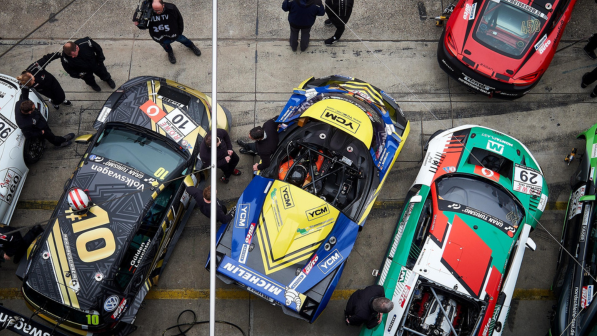
Hospitality May be the Most Valuable Asset
TV exposure gets the headlines. But some of the most valuable business at the Indy 500 doesn’t happen on camera at all.
Corporate hospitality has become one of the race’s most valuable sponsorship assets. Suites, pit access, garage tours, and VIP experiences allow companies to entertain clients, reward employees, and build relationships in a high-energy environment.
In many cases, the true ROI of a motorsports partnership comes from the business relationships created during race weekend rather than from media impressions alone.
Deals are discussed in suites. Partnerships are strengthened in hospitality areas. Relationships are built through shared experiences.
That is part of what makes the Indy 500 unique compared to traditional advertising channels.
Drivers Have Become Media Brands
The modern IndyCar driver is no longer just defined by performance on race day. They’re content creators, brand voices, podcast hosts, and social media presences, and sponsors know it.
Social media has fundamentally changed how fans connect with the sport. Drivers are now able to build direct relationships with audiences in real time, sharing behind-the-scenes moments, personal perspectives, training routines, and race-weekend experiences. This level of access has turned drivers into everyday storytellers, not just athletes in helmets.
For sponsors, that shift has created an entirely new layer of value. A driver’s impact is no longer limited to what happens on track. Their personality, online presence, and ability to engage fans now play a major role in shaping partnership decisions.
This has also changed how sponsorships are activated.
Instead of relying solely on traditional logo placement, brands now expect drivers to participate in content creation, social campaigns, and storytelling that continues throughout the season. The most effective partnerships are the ones where the driver becomes a natural extension of the brand’s voice, not just a visual asset on the vehicle.
Why The Indy 500 Still Matters
In an era filled with endless content and fragmented attention spans, the Indy 500 continues to stand out because it combines tradition, scale, speed, community, and business opportunities all in one weekend.
Very few sporting events can offer all of those elements simultaneously.
The race remains one of the rare sports spectacles where brands, fans, athletes, and businesses all intersect in a meaningful way. Whether through sponsorships, experiential activations, hospitality, or content creation, the Indy 500 continues to generate value far beyond the racetrack.
And as sports marketing keeps pushing toward authentic storytelling and experience-driven engagement, the business case for the Indy 500 only gets stronger.
The race itself is great. But what happens around it? That might be the real show.
FAQ:
- How much do IndyCar sponsorships cost? Costs vary depending on the level of partnership. Associate sponsorships can range from low six figures, while primary or full-season deals can reach into the millions. The Indy 500 itself often commands premium pricing because of its global visibility and concentrated audience.
- How does the Indy 500 make money? Revenue comes from multiple streams including ticket sales, corporate hospitality suites, sponsorship deals, broadcast rights, merchandise, and event-week activations. Unlike many sports, a significant portion of value is also created indirectly through tourism and brand-driven spending across the city.
- Why does the Indy 500 winner drink milk? The milk tradition started in 1936 when winner Louis Meyer drank buttermilk in victory lane after his win. A dairy executive turned it into a marketing moment, and the tradition stuck. Today, every winner of the Indianapolis 500 is offered milk on the podium, choosing from whole, 2%, or skim. It’s now one of the most iconic victory traditions in sports.
- How much money does the Indy 500 winner make? The winner of the Indianapolis 500 typically earns around $2 million or more, depending on the yearly prize purse. The total purse has recently exceeded $15 million, with payouts distributed across the full finishing order.
- Do sponsors pay drivers directly? In many cases, sponsors fund teams rather than paying drivers directly. However, drivers often benefit through contracts that include salary, bonuses, and personal endorsement opportunities tied to their sponsor relationships.