
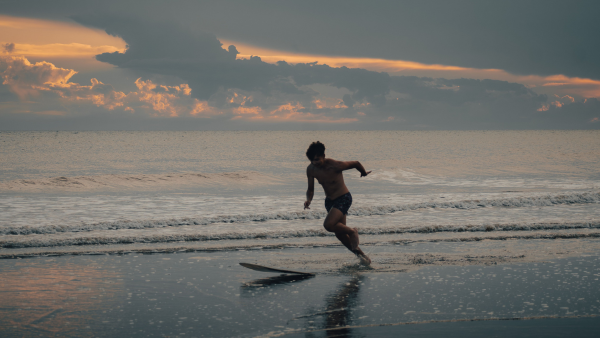
A rider sprints across wet sand, drops a board at their feet, and within seconds is hurtling toward an incoming wave. They launch off the lip, pull an aerial trick, and stick the landing on a few inches of foam and fiberglass.
It’s called skimboarding, and while it might look like a beach pastime, it has a legitimate professional circuit, world-class athletes, and a century of history behind it.
Sitting at the crossroads of surfing and its own entity, skimboarding provides casual fans and viewers alike an opportunity to witness a sport that is consistently growing.
Quick Highlights
- Skimboarding began around 1920 in Laguna Beach, California, giving the sport more than a century of history.
- The largest events on the United Skim Tour (UST) have offered prize purses of up to $15,000 for a single competition.
- Three-time UST champion Blair Conklin has built an audience of nearly 4 million YouTube subscribers and more than 3.7 billion views, demonstrating the sport’s growing digital footprint.
- The first annual World Skimboard Championships were launched in 1976, and The Vic at Aliso Beach is now in its fifth decade as the sport’s most prestigious event.
Where It All Started
Skimboarding’s origins trace back to Laguna Beach, California, around 1920. Two local lifeguards, George Griffeth and a friend known only as Jimmy, fashioned rounded disks from redwood and used them to glide across the shallow water along the shore.
It was practical as much as playful. It was a way to travel quickly between coves along Laguna’s hilly coastline, where traditional surfing was largely blocked by the Channel Islands.
For decades, the sport stayed small and local. The classic “pizza board” shape dominated through the 1950s. Then, in the early 1960s, Laguna locals began stretching those round boards into oval shapes to better carve into the waves that crashed right on shore.
That design shift changed everything.
The next major leap came in 1976, when Tex Haines and Peter Prietto founded Victoria Skimboards: a brand that would become synonymous with the sport itself. That same year, they organized the first annual World Skimboard Championships at Aliso Beach. The sport now had a name (before Victoria, it was often called “skidboarding”), a dedicated manufacturer, and a competition.
In 1980, Victoria introduced the first foam core skimboard covered in fiberglass and resin, bringing the boards into surf shops and serious sporting culture. In 1987, a Sports Illustrated cover featuring Laguna Beach lifeguard Tom Trager catching air gave skimboarding a mainstream spotlight that almost no niche sport ever gets.
What Professional Skimboarding Actually Looks Like
Competitive skimboarding can be broken into two disciplines.
- Wave skimboarding, the more high-profile form, involves riders running down the beach, throwing their board, stepping on, and racing out to meet incoming shore break. The goal is to hit the wave, launch off it, and execute aerial maneuvers before riding back to shore. Tricks range from back-side wraps to aerial floaters to full rotations above the lip.
- Flatland skimboarding, more common inland, trades ocean waves for smooth surfaces such as rain puddles, wet pavement, or shallow flats. Flatland skimboarding has an emphasis on technical tricks closer to skateboarding’s street style.
At the professional level, wave riding is king. Competitions are judged on wave selection, speed, trick difficulty, and execution. This format rewards both athletic power and creative risk-taking.
Surfing Versus Skimboarding
At first glance, surfing and skimboarding look like cousins. Both involve riding waves, demand balance and athleticism, and are deeply tied to beach culture. But the two sports are fundamentally different in how they interact with the ocean.
Surfers paddle out beyond the break, waiting for waves to form and carry them toward shore. Skimboarders do the opposite, as they start on the beach and sprint toward the water. They then use the thin film of wash left by a receding wave to glide out and meet the shore break as it arrives.
Surfboards are large, buoyant, and designed to float. Skimboards are thin, dense, and have virtually no float at all. They rely entirely on speed and momentum to stay on top of the water. Waves in surfing are ridden for distance. In skimboarding, the wave is more of a launching ramp for a trick.
The result is a sport that’s faster, more explosive, and confined to a narrow strip of shore.
Surfing is known to be easier to learn, as well as provides a longer and more predictable ride. These traits have led it to be more marketable for television and competition. With more sponsorships and training opportunities, athletes can begin to shape skimboarding into the worldwide force professional surfing is.
The Leagues: Where Pros Compete
The main international circuit for professional skimboarding is the United Skim Tour (UST), widely recognized as the world’s only international professional skimboard tour.
The UST sanctions events on both coasts of the United States and occasionally abroad, drawing riders from Brazil, Mexico, Japan, and across Europe. A typical season runs through summer and early fall, with stops at iconic locations including Laguna Beach in California, Dewey Beach in Delaware, Nags Head in North Carolina, and Santa Cruz.
The flagship event of the professional calendar is the Vic World Skimboard Championship (“The Vic”) held every August at Aliso Beach in Laguna Beach. Now in its fifth decade, it is the longest-running and most prestigious skimboarding competition in the world. Winning The Vic carries the same weight in skimboarding that winning Pipe Masters carries in surfing.
On the East Coast, the Zap Pro/Am World Championships held at Dewey Beach, Delaware is another major stop. Prize money is awarded to the top finishers in both men’s and women’s professional divisions. The European Skimboard League serves the growing international scene overseas, and Skim USA organizes regional competitions that feed talent into the professional ranks.
The Sponsorship Reality
The sport operates in what riders themselves have described as “no-man’s land.”
Prize purses are real but modest. The largest on the UST circuit have reached $15,000 for a single event. Meaningful, but nowhere near enough to sustain a career on its own.
The brands that anchor skimboarding sponsorships are largely endemic to the sport and surf culture: Victoria Skimboards, Zap Skimboards, Exile Skimboards, CatchSurf, and reef sandal brand Reef are among the most visible. These companies provide boards, gear, and in some cases financial support to their sponsored athletes, but rarely at the level that allows full-time professional focus without supplementary income.
The more interesting sponsorship story is happening through social media and content creation. Professional skimboarders have become some of the most compelling athletes on YouTube and Instagram, precisely because their sport is so visually explosive and underexposed.
Blair Conklin, a three-time UST champion from Laguna Beach, has built a YouTube channel (SkidKids) with nearly 4 million subscribers and over 3.7 billion views. His sponsors include DJI (the drone camera company), I-SEA sunglasses, CatchSurf, Reef, and Exile.This mix of surf brands and technology companies value his reach as a content creator just as much as his competitive credentials.
Lucas Fink, the Brazilian phenom who has won four UST championships including three in a row from 2022 to 2024, has the backing of Red Bull, a rare mainstream crossover sponsorship that signals growing confidence from major brands in skimboarding’s audience potential. Red Bull’s involvement brings production-quality content, global distribution, and the kind of brand legitimacy that elevates an entire sport.
The Road Ahead
Professional skimboarding sits at a fascinating crossroads. Its core infrastructure, the UST, The Vic, the Zap Championships, is well established and growing. Its athletes are among the most creative wave riders in any discipline.
What it still lacks is the broadcast deal, the mainstream sponsor roster, and the mainstream name recognition that would push it from niche obsession to household sport. Whether Red Bull’s involvement and the rise of creators like Conklin signal the beginning of that shift remains to be seen.
But make no mistake: skimboarding has been here since 1920, and its best riders are competing, creating, and pushing the sport’s limits every summer, with or without the mainstream spotlight.
That’s what makes it worth watching.
FAQ:
- What makes skimboarding different from surfing? Unlike surfers, who paddle out and wait for waves, skimboarders start on the beach, sprint toward the water, and use speed and momentum to reach an incoming shore break. The wave becomes a launch point for tricks rather than a ride toward shore.
- Why is skimboarding so popular on social media? The sport’s biggest maneuvers happen close to shore, making them easy to film and visually impressive. High-flying aerials, wave tricks, and beach-level camera angles have helped skimboarding attract millions of views online.
- Can you actually make a living as a professional skimboarder? For most riders, competition earnings alone aren’t enough. While major events offer prize money, many professionals rely on sponsorships, coaching, and content creation to support their careers.
- Why are most professional skimboarders from California? Southern California, particularly Laguna Beach, has the steep shore breaks that are ideal for wave skimboarding. The region’s history, culture, and consistent conditions have made it the sport’s global hub for more than a century.
- Why aren’t skimboarders in the Olympics? The sport remains relatively small compared to surfing and skateboarding, with limited international participation and governing infrastructure. Olympic inclusion would require significant global growth and organizational support.