
A History of Women in Sports: The Untold Stories That Changed the Game
When people talk about women in sports history, the same moments tend to come up: Billie Jean King’s “Battle of the Sexes,” the rise of the WNBA, or the first women to run in the Olympics. Those moments matter, but they’re only part of a much larger story.
Long before sponsorship deals and packed arenas, women were competing anyway: pushing boundaries, defying stereotypes, and demanding visibility.
That legacy lives on in today’s elite female athletes, including the women represented by Athelo Group:
- CrossFit: Dani Speegle
- Fitness influencers: Kyra Milligan, Sarah Bäckman
- Arm wrestling: Sarah Bäckman
- Water sports: Brisa Hennessy, Zoe Benedetto
- Golf: Sydney Grimes
- Combat: Sarah Thomas
- (and many others)
This article is about the lesser-known milestones that reshaped sports history—the first steps, the quiet breakthroughs, and the unsung victories that made today’s achievements possible.
For young athletes reading this: this is your lineage, too.
Quick Highlights:
- First Olympic Women (1900): Only 22 women competed in tennis and golf at the Paris Games.
- Title IX Impact (1972): Participation exploded—from 1 in 27 girls in high school sports to nearly 1 in 2 today.
- Barrier-Breaking Champions: Charlotte Cooper won the first female Olympic gold; Alice Milliat organized the first Women’s Olympiad.
- Professional Leagues: WNBA launched in 1997, following decades of limited professional opportunities.
- Modern Milestones: 2012 Olympics included women in every sport; NIL deals now let female college athletes earn major endorsements.
Ancient & Pre-Modern Women in Sports (Before 1900)
Women Athletes in Ancient Civilizations
Did you know women competed in sports thousands of years before the modern Olympics?
In ancient Egypt, women participated in swimming, rowing, sprinting, and ball games—activities depicted in murals from as early as 2000 BCE. These weren’t just recreational; they were celebrated athletic pursuits demonstrating strength and skill.
In Rome, some women trained with weights and performed exercises similar to modern gymnastics. Archaeological evidence even shows female gladiators existed, though rarely.
Across Africa, athletic contests were woven into cultural festivals and rites of passage. Women’s participation in track and field-like competitions wasn’t a modern invention—it was reclaimed tradition.
Indigenous and Native American Women’s Sports Traditions
Long before European contact, Indigenous women played stickball and lacrosse-like games, ran endurance races, and participated in competitions tied to ceremony and community life.
In some Native American cultures, women’s lacrosse games could involve hundreds of players and last for days. Athletic ability was valued as part of preparing women for leadership roles in society.
This rich sports tradition predates organized women’s sports by centuries.
The Games of Hera: The First Women’s Athletic Competition
While men competed in the ancient Olympic Games, women had their own showcase: the Heraean Games.
Held every four years at Olympia in honor of the goddess Hera, these foot races featured young women competing in three age categories.
What winners received:
- Olive wreaths
- Portions of a sacrificed cow
- The right to dedicate statues with their names inscribed
The Games of Hera prove that structured, celebrated women’s athletic competition existed more than 2,500 years ago.
Cynisca of Sparta: The First Female Olympic Champion (396 BCE)
Here’s a lesser-known fact: The first female Olympic champion competed in 396 BCE.
Cynisca of Sparta didn’t run or throw. Nope, Cynisca owned the winning four-horse chariot team at the ancient Olympics. Olympic rules forbade women from competing or even attending, but there was a loophole: chariot owners, not drivers, received the victory.
She was so proud she commissioned a bronze statue with an inscription declaring:
“Kings of Sparta were my fathers and brothers, and I, Cynisca, winning the race with my chariot of swift-footed horses, erected this statue. I assert that I am the only woman in all Greece to have won this crown.”
The lesson: Breaking barriers often required both strategy and courage, not just athletic talent.
The Victorian Era: When Women Were “Too Fragile” for Sports (1800s-Early 1900s)
Debunking the Myths: False Medical Claims About Women and Exercise
The Victorian era represents the low point for women in sports. Medical authorities—almost exclusively men—declared women’s bodies fundamentally unsuited for athletics.
The absurd claims:
- Running could damage reproductive organs
- Cycling caused “bicycle face” (a permanent grimace) and hysteria
- Competitive sports would grow unseemly muscles and ruin femininity
- Vigorous exercise would divert blood from vital organs
- Women’s weaker constitutions couldn’t handle athletic stress
Of course, none of this was scientific. These were social barriers disguised as medicine, designed to keep women confined to domestic roles.
Women defied them anyway.
Early Athletic Clubs and Underground Women’s Competitions
While public sports remained largely forbidden, determined women created their own opportunities.
By the 1860s and 1870s, women’s athletic clubs began forming in secret or semi-secret locations across Europe and America. Women organized:
- Tennis tournaments
- Archery competitions
- Croquet matches
- Ice skating exhibitions
Sometimes these were held on private estates or women-only spaces to avoid social censure. The first women’s golf tournament took place in 1811 in Scotland, though it would be decades before women’s golf gained broader acceptance.
In colleges, female students formed basketball teams, field hockey clubs, and track associations despite institutional resistance. These underground sports cultures kept women’s athletics alive during its darkest period.
Mary, Queen of Scots and Early Women Golfers
Most people don’t know that women played golf centuries before formal competitions existed.
Mary, Queen of Scots, was a regular golfer in the 1560s, and was actually criticized for playing golf days after her husband’s murder. Now that’s dedication!
By the 1800s, women formed golf clubs across Scotland and England. The Ladies’ Golf Union, founded in 1893, was one of the first national sports governing bodies for women anywhere in the world.
Elizabeth Wilkinson: The First Female Boxing Champion (1722)
Long before Ronda Rousey or women’s MMA, Elizabeth Wilkinson became the first recorded female boxing champion in 1722.
Wilkinson competed publicly in London, fighting other women for prize money in matches advertised in newspapers. Her fights drew large crowds and significant wagering.
She proved women could fight, perform, and earn respect—and money—in traditionally male sports, more than 200 years before modern women’s combat sports gained mainstream acceptance.
Breaking Into the Olympics: The First Steps (1900-1928)
1900 Paris Olympics: 22 Women Change Everything
The first modern Olympics in 1896 excluded women completely. Founder Pierre de Coubertin believed women’s participation would be “impractical, uninteresting, unaesthetic, and incorrect.”
By 1900, social pressure forced a tiny concession: 22 women competed in tennis and golf at the Paris Olympics. Organizers framed the female competitions as mere “demonstration events,” but these pioneering sportswomen forced the Olympics to acknowledge women’s athletic abilities.
Over the next several decades, women would have to fight for every single sport added to the Olympic program.
Charlotte Cooper: The First Female Olympic Gold Medalist (1900)
Charlotte Cooper won gold in tennis singles at the 1900 Paris Olympics, becoming the first female Olympic champion of the modern era.
Her challenges:
- Competed while partially deaf, using visual cues to track the ball
- Wore restrictive long skirts and corsets required by social convention
- Already a five-time Wimbledon champion before Olympic recognition
She won gold again in mixed doubles, proving herself a versatile and dominant athlete.
The 1921 Women’s Olympiad in Monaco (Often Overlooked)
Here’s a milestone that rarely makes it into history books:
When the IOC refused to include women in track and field, French athlete and activist Alice Milliat organized an alternative: the Women’s Olympiad in Monaco in 1921.
This international track and field competition featured athletes from five countries competing in 11 events. The performances were impressive: world records fell, and attendance proved strong public interest.
The result: The IOC, embarrassed and fearing a permanent rival organization, grudgingly agreed to add some women’s track events to the 1928 Olympics.
The lesson: Women didn’t wait for permission. They created their own opportunities and forced institutions to catch up.
Alice Milliat: The Woman Who Forced the IOC’s Hand
Alice Milliat deserves to be as famous as any male Olympic founder.
The French rower and sports administrator founded the Fédération Sportive Féminine Internationale (FSFI) in 1921 after the IOC refused to expand women’s Olympic participation.
What she accomplished:
- Organized the 1921 Women’s Olympiad
- Created the Women’s World Games (1922, 1926, 1930, 1934)
- Drew thousands of athletes and spectators to international competitions
- Proved women could compete at elite levels across all track and field disciplines
Her activism directly led to women’s track and field being added to the Olympics in 1928. Today’s female athletes owe Milliat an enormous debt.
1928 Amsterdam: Women Finally Get Track and Field
Women finally competed in Olympic track and field in 1928, though officials limited them to just five events (compared to 22 for men).
The controversy: Several runners collapsed after the 800-meter race—not from physical incapacity but from running a distance they’d never been allowed to train for properly.
Instead of recognizing the training gap, officials used the incident to justify removing the women’s 800m from the Olympics entirely. It wouldn’t return until 1960.
The pattern throughout history: Women performed incredibly despite limited opportunities, and any struggle was used to justify further restrictions rather than better support.
The legacy: Betty Robinson won the first women’s 100m gold medal at just 16 years old, starting a legacy that would eventually include legends like Wilma Rudolph, Florence Griffith Joyner, and Allyson Felix.
Pioneers You Should Know: Lesser-Known Trailblazers (1920s-1960s)
Tuskegee Institute Athletes: Louise Stokes and Tidye Pickett
Louise Stokes and Tidye Pickett became the first Black women selected for the U.S. Olympic team in 1932.
The heartbreak: Despite making the team, White coaches replaced them with White athletes for the actual competition.
The resilience: Four years later, both made the 1936 Olympic team again. This time Pickett competed in the 80m hurdles, becoming the first Black American woman to compete in the Olympics.
Their determination despite racism, exclusion, and heartbreak paved the way for future Black female athletes. Tuskegee would go on to train numerous Olympic champions, including the legendary Wilma Rudolph.
Read more about Stokes and Pickett in our blog post, African American Women Pioneers in Sports.
Alice Coachman: First Black Woman to Win Olympic Gold (1948)
Alice Coachman grew up in Albany, Georgia, during the Depression, training on dirt roads and makeshift equipment because segregation barred her from public facilities.
She improvised high jump bars from ropes and sticks, building her skills through determination and natural talent.
The achievement: In 1948, Coachman cleared 5 feet, 6⅛ inches to win Olympic gold in the high jump, making her the only American woman to win a track and field gold medal that year and the first Black woman from any country to win Olympic gold.
The reality of returning home: Albany held a segregated parade in her honor, with White spectators on one side of the street, Black spectators on the other. She wasn’t even allowed to speak at her own ceremony.
Coachman’s grace under pressure and athletic excellence inspired generations of athletes.
Gertrude Ederle: Breaking Men’s Records Swimming the English Channel (1926)
In 1926, 19-year-old Gertrude “Trudy” Ederle became the first woman to swim the English Channel … and she did it faster than any of the five men who had accomplished the feat before her.
The numbers: Ederle completed the 21-mile swim in 14 hours and 31 minutes, beating the previous men’s record by nearly two hours.
The celebration: When Ederle returned to New York, an estimated two million people lined the streets for her ticker-tape parade—a larger crowd than had greeted Charles Lindbergh.
The impact: Her triumph showed that women’s endurance could not just match but exceed men’s in extreme conditions, challenging fundamental assumptions about female athletic capability.
Ora Washington: Dominating Tennis and Basketball While Fighting Racism
Ora Washington may be the greatest female athlete most people have never heard of.
Her dominance: From the 1920s through the 1940s, Washington won dozens of national championships in the segregated American Tennis Association (ATA) and led her basketball team to 11 consecutive championships.
The injustice: Washington repeatedly challenged White tennis champions to integrated matches—challenges they refused, unwilling to risk defeat by a Black woman.
The truth: Historical accounts suggest Washington was likely better than most, if not all, of her white contemporaries who received far more recognition and opportunities.
She played basketball with an aggressive, athletic style decades before it became common in women’s games, earning nicknames like “The Queen of Tennis.”
Louise Pound: Setting Rifle Records When Women “Weren’t Athletic”
Louise Pound, a scholar and athlete in the early 1900s, held competitive shooting records when women supposedly weren’t capable of athletics.
Her versatility: She also excelled in ice skating, cycling, and tennis, becoming a champion in multiple sports while simultaneously earning advanced degrees and teaching at the University of Nebraska.
Pound’s story matters because she defied every Victorian stereotype about female fragility. She proved women could excel in precision sports requiring steady nerves and sustained concentration—skills society claimed women lacked.
Enriqueta Basilio: First Woman to Light the Olympic Flame (1968)
When Mexican hurdler Enriqueta Basilio carried the Olympic torch up the stadium stairs and lit the cauldron at the 1968 Mexico City Olympics, she made history as the first woman ever chosen for this symbolic honor.
The controversy: Some traditionalists protested that a woman shouldn’t perform such a prestigious Olympic duty.
The impact: Her composed, confident torch-lighting ceremony silenced critics and set a precedent. Today, women regularly light Olympic cauldrons, but Basilio was the first.
The Water Sports Revolution: Women Conquering the Waves
Early Women Surfers Who Defied Beach Culture Norms
Professional surfing’s roots include women from the beginning.
Ancient Hawaii: Women surfed alongside men, with some female ali’i (royalty) becoming renowned surfers.
The setback: When missionaries arrived in the 1800s, they discouraged surfing for everyone but particularly disapproved of women surfing in “immodest” attire.
The revival: As surfing experienced a comeback in the early 1900s, women like Isabel Letham in Australia and Mary Ann Hawkins in California pioneered modern women’s surfing.
The challenges: They faced beach culture norms that deemed surfing unladylike and restrictions on women’s beach access and swimwear.
The 1960s breakthrough: Women like Marge Calhoun and Linda Benson were competing professionally, though prize money remained minimal and sponsorship nearly nonexistent.
Today’s legacy: These pioneers created the foundation for today’s professional female surfers like Athelo Group’s Brisa Hennessy, who compete for substantial prizes and global recognition.
Gertrude Ederle’s Historic English Channel Swim (1926)
Ederle’s Channel swim deserves mention here too for its impact on water sports specifically.
The moment that defined her: The swim almost didn’t happen—her trainer tried to pull her from the water when she struggled, but Ederle shouted, “What for?” and kept swimming.
That determination epitomizes the spirit of every woman who refused to accept limitations others tried to impose.
Diana Nyad: The 64-Year-Old Who Swam Cuba to Florida (2013)
Diana Nyad’s 110-mile swim from Cuba to Florida in 2013 rewrote assumptions about age, gender, and extreme endurance.
The achievement: At 64, after four previous failed attempts, Nyad completed the 53-hour swim without a shark cage, a feat that had eluded both men and women for decades.
Why it matters:
- Challenged beliefs about what women can achieve at ages society considers “past prime”
- Proved determination, training, and mental fortitude can overcome physical barriers
- Showed young female athletes that their athletic lives don’t have to peak in their 20s
Women’s Surfing Added to Olympics (2020)
It took until 2020 for women’s surfing to gain Olympic recognition, despite women surfing competitively for over a century.
What it took: Decades of advocacy by female surfers who built professional tours, attracted sponsors, and proved that women’s surfing could draw audiences and generate excitement.
The first champion: Carissa Moore won the first Olympic gold medal in women’s surfing.
Today: Elite female surfers, including those represented by Athelo Group, compete on the world’s biggest stages—opportunities that didn’t exist even 20 years ago.
Title IX: The Law That Changed Everything (1972)
What Title IX Actually Did
Title IX is just 37 words long:
“No person in the United States shall, on the basis of sex, be excluded from participation in, be denied the benefits of, or be subjected to discrimination under any education program or activity receiving Federal financial assistance.”
In practice: Schools receiving federal funding—almost all public schools and many private ones—could no longer discriminate based on sex in any educational program, including athletics.
The requirement: Schools had to provide equal opportunities for boys and girls. The law didn’t require identical programs, but it required fairness.
The result: That single requirement changed millions of lives.
The Numbers That Tell the Story: Before and After
Before Title IX (1971):
- 1 in 27 girls played high school sports
- Fewer than 30,000 women participated in college sports
- Athletic scholarships for women were virtually nonexistent
- Many schools offered zero sports for girls
After Title IX (2020s):
- More than 1 in 2 girls play high school sports
- Over 200,000 women participate in college sports
- Women receive over 40% of college athletic scholarships
- Female athletes have access to sports from elementary school through professional leagues
These aren’t just numbers; they represent millions of girls who got to play, train, compete, and develop as athletes.
How Title IX Impacted Different Sports Differently
Explosive growth:
- Basketball and soccer participation increased by thousands of percent
- High schools and colleges built women’s basketball programs that became sources of school pride
Steady expansion:
- Lacrosse and field hockey grew steadily, particularly in schools with strong existing programs
- Softball became the female equivalent of baseball
Ongoing challenges:
- Wrestling faced difficulties creating equivalent women’s opportunities
- Football’s large roster sizes and budgets created Title IX compliance debates
- Some sports like gymnastics sometimes got cut when schools eliminated programs rather than adding women’s sports
Bottom line: Despite complications, Title IX fundamentally transformed the landscape. Popular athletes today, from basketball stars to soccer champions, owe their opportunities to this law.
Modern Milestones: The Professional Era (1970s-1990s)
Billie Jean King Defeats Bobby Riggs: The “Battle of the Sexes” (1973)
On September 20, 1973, over 90 million people worldwide watched Billie Jean King defeat Bobby Riggs in the famous “Battle of the Sexes” tennis match.
The setup:
- King, 29, faced the 55-year-old former champion
- She won in straight sets, earning $100,000
- Riggs had been claiming women’s tennis was inferior
Why it mattered: The match was theater, but the stakes were real. King understood that losing would set women’s tennis back years, providing ammunition to those arguing women didn’t deserve equal prize money.
The broader impact:
- Legitimized women’s professional tennis
- Strengthened arguments for equality across all sports
- King’s activism extended far beyond the court: she fought for equal prize money, founded the Women’s Tennis Association, and created opportunities for future generations
Kathrine Switzer Forces Her Way Into the Boston Marathon (1967)
In 1967, women were officially banned from running marathons, as authorities claimed the distance was medically dangerous for women.
The strategy: Kathrine Switzer registered for the Boston Marathon as “K.V. Switzer,” hiding her gender to get a race number.
The attack: When race official Jock Semple spotted her on the course, he tried to physically rip off her race number, shouting, “Get the hell out of my race!”
The finish: Switzer’s boyfriend and fellow runners blocked Semple, and she finished the race in about 4 hours and 20 minutes.
The legacy: The famous photographs of Semple attacking Switzer became symbols of the barriers women faced and the determination required to overcome them.
The timeline:
- 1972: Boston officially allowed women
- 1984: Women’s marathon added to the Olympics
The All-American Girls Professional Baseball League (1943-1954)
During World War II, while men fought overseas, the All-American Girls Professional Baseball League (AAGPBL) gave women professional opportunities in America’s pastime.
The facts:
- Ran from 1943-1954
- Featured teams across the Midwest
- Drew millions of fans
- Players like Dorothy Kamenshek became stars
The end: When the war ended and men returned, support for women’s professional baseball evaporated. The league folded in 1954.
What it proved: Given opportunity and promotion, women’s sports could attract large audiences and generate revenue—lessons that would eventually lead to the WNBA and other professional women’s leagues.
The Birth of the WNBA (1997)
After decades of failed attempts at professional women’s basketball leagues, the WNBA launched in 1997 with eight teams and backing from the NBA.
The stars: Lisa Leslie, Sheryl Swoopes, and Rebecca Lobo became household names, proving that women’s basketball could draw fans, television coverage, and sponsorships.
The challenges:
- Lower pay than male counterparts
- Less media coverage
- Financial struggles
Why it matters: The league has survived for over 25 years, providing professional opportunities for hundreds of players. Athletes who grew up watching WNBA stars now play in the league themselves, creating generational continuity.
Women’s Soccer World Cup Fills Stadiums (1999)
The 1999 FIFA Women’s World Cup, hosted by the United States, shattered attendance records and captured the nation’s attention.
The moment: Over 90,000 fans packed the Rose Bowl for the final, watching the U.S. defeat China on penalty kicks. Brandi Chastain’s celebration after scoring the winning penalty—falling to her knees and pulling off her jersey—became one of the most iconic images in sports history.
The impact:
- Proved women’s soccer could generate massive interest
- Players like Mia Hamm, Julie Foudy, and Kristine Lilly became role models for millions
- Youth soccer participation among girls exploded, though increased participation also highlighted the need for better injury prevention research, particularly around ACL injuries.
The significance: Women’s sports achieving mainstream, must-see status and demonstrating that female athletes could become cultural icons.
Breaking New Ground: Extreme Sports and Unconventional Athletics (1990s-2010s)
Women in Motocross and Extreme Sports
For decades, motocross and action sports were considered exclusively male domains—too dangerous, too aggressive, too “extreme” for women.
Female riders proved otherwise:
Ashley Fiolek: Deaf from birth, became multiple-time WMA Women’s Motocross Champion, proving that determination and skill matter more than hearing or gender.
Tarah Gieger: Competed professionally in both motocross and surfing, embodying the multi-sport athleticism that characterizes modern action sports culture.
Today: Women compete in nearly every extreme sport: BMX, skateboarding, snowboarding, wakeboarding, and more. Led by athletes represented by Athelo Group, women in motorsports and other extreme sports continue pushing boundaries.
The ongoing fight: These athletes compete not just for opportunities but for equal prize money, media coverage, and respect in male-dominated sporting cultures.
Ronda Rousey: First Woman in UFC (2012)
When Ronda Rousey signed with the UFC in 2012, she broke the organization’s long-standing policy of excluding women.
The backstory: UFC President Dana White had repeatedly stated women would never fight in the UFC—but Rousey’s dominance in Strikeforce and her marketability convinced him to change his mind.
The impact beyond individual success:
- Opened the door for women’s MMA
- Led to multiple women’s weight classes
- Created main event fights featuring female athletes
- Provided opportunities for hundreds of women to compete professionally
- Showed how social media could amplify UFC athletes’ reach and marketability
The broader cultural shift: Rousey showed that women’s combat sports could headline pay-per-views and generate millions in revenue. Her crossover to mainstream fame demonstrated that female athletes in “violent” sports could achieve mainstream acceptance.
Women’s MMA and Combat Sports Acceptance
Following Rousey’s breakthrough, women’s MMA has produced stars across weight classes:
- Amanda Nunes
- Valentina Shevchenko
- Rose Namajunas
- Weili Zhang
Women’s boxing experienced similar growth with fighters like Katie Taylor and Claressa Shields.
What it represents: A fundamental shift in societal attitudes. For centuries, physical aggression and combat were considered fundamentally unwomanly. Today, female fighters are celebrated athletes, and young girls can aspire to careers in boxing, MMA, and other combat sports.
CrossFit and the Rise of Women’s Strength Sports
CrossFit, founded in 2000, created a culture where female strength was celebrated from the start. In fact, women in CrossFit have become some of the sport’s biggest stars.
The equality: The CrossFit Games has featured equal events and equal prize money for men and women since its inception—parity that remains rare in professional sports.
The stars:
- Tia-Clair Toomey: Five-time CrossFit Games champion
- Athelo Group athletes like Dani Speegle: Showcasing strength, power, and athletic versatility
The cultural shift: CrossFit normalized heavy lifting, muscle definition, and powerful physiques for women—athletic qualities once stigmatized as “unfeminine.”
The impact: The sport’s emphasis on functional fitness—not aesthetics—helped shift cultural conversations about women’s bodies and athleticism. Top female CrossFit athletes like Brittany Weiss are strong, muscular, and proud of their physical capabilities.
Action Sports Athletes Breaking Gender Barriers
Beyond motocross, women have revolutionized action sports:
Skateboarding: Elissa Steamer became one of the first women featured in major video games alongside male pros.
Snowboarding: Chloe Kim won Olympic gold at 17.
BMX: Hannah Roberts dominates freestyle competitions, landing tricks few men attempt.
Olympics impact: When skateboarding debuted at the 2020 Olympics, 13-year-old Rayssa Leal won silver, showing how young women are pushing technical boundaries.
The key difference: These athletes don’t compete in “women’s versions” of their sports. Rather, they attempt the same tricks, ride the same courses, and push progression alongside male counterparts.
Lacrosse Legacy: Women’s Version Predates Men’s Modern Game
Women’s Lacrosse: A Different Game With Its Own Rules
Here’s something most people don’t know: Women’s lacrosse evolved separately from men’s lacrosse and maintains distinct rules emphasizing skill and strategy over physical contact.
The differences:
- Men’s lacrosse allows significant body checking and physical play
- Women’s lacrosse limits contact, creating a faster, more finesse-oriented game
Why it’s different: When women’s lacrosse was formalized in the late 1800s, women athletes and educators chose to create a game that emphasized ball skills, positioning, and strategy.
The result: A genuinely different sport with its own identity, not just a modified version of the men’s game.
Today: Women’s lacrosse maintains distinct stick designs, field markings, and rules. Athletes like Alex Aust, represented by Athelo Group, exemplify the speed, skill, and tactical awareness that define elite women’s lacrosse.
First Women’s Lacrosse Game (1890)
The first women’s lacrosse game was played in 1890 in Scotland, just four years after the modern women’s game was formalized.
U.S. growth: The first U.S. game was played in 1926 at the Bryn Mawr School in Baltimore.
Steady development: Women’s lacrosse grew in schools and colleges, particularly in the Northeast and Mid-Atlantic regions, even as it remained largely unknown in much of the country.
How Women’s Lacrosse Became an NCAA Sport
1982: Women’s lacrosse gained NCAA recognition. The first NCAA Division I championship was held that year, won by the University of Massachusetts.
Growth explosion: Since then, women’s lacrosse has become one of the fastest-growing high school and college sports in America.
Today’s numbers: Over 400 colleges offer women’s lacrosse programs, with thousands of girls playing in high schools across the country.
The lesson: Providing opportunities and visibility allows sports to flourish. Women’s lacrosse went from niche sport to mainstream athletics in just a few decades.
The Ongoing Fight: Contemporary Challenges (2000s-Present)
Pay Equity in Professional Sports (USWNT, WNBA, Tennis)
Despite enormous progress, pay equity remains a major issue.
U.S. Women’s National Soccer Team:
- The most successful program in international soccer history
- Fought for years for equal pay with the far less successful men’s team
- Reached a settlement in 2022, guaranteeing equal pay for equal work
WNBA:
- Players earn a fraction of NBA salaries
- Many play overseas in the offseason to supplement income
- Top WNBA players still earn far less than even minimum NBA salaries
Tennis:
- The only major sport with near-equal pay at major tournaments
- Result of decades of advocacy by players like Billie Jean King
- Still shows disparities in endorsement deals and media coverage outside Grand Slams
What it means: The gender pay gap in sports isn’t just about money—it’s about valuing women’s athletic achievements equally to men’s.
Media Coverage Disparity: The 4% Problem
The reality: Women’s sports receive a fraction of sports media coverage (roughly 4%), despite women comprising nearly half of all athletes.
The cycle:
- Less coverage means less fan development
- Sponsors cite low fan interest to justify lower investment
- Fewer resources lead to fewer competitive opportunities
- Reinforces the notion that women’s sports are less important
The impact on young athletes: Girls grow up seeing male athletes celebrated constantly while female athletes remain largely invisible. This affects not just professional opportunities but also how girls perceive their own athletic worth.
Signs of progress: Dedicated streaming platforms, increased ESPN coverage, and reality shows like The Ultimate Surfer showcasing women’s surfing have started to shift this … but progress remains slow.
The 2012 Olympics: First Time All Sports Included Women
The 2012 London Olympics made history as the first Games where every sport included women’s events.
Boxing: The last holdout finally added women’s divisions, allowing athletes like Claressa Shields to win gold.
The timeline: This milestone took 116 years from the first modern Olympics, marking over a century of advocacy before full inclusion.
Ongoing issues: Even today, some events maintain disparities. Women ski jumpers weren’t allowed in the Olympics until 2014.
What it shows: Progress is both real and recent. Today’s young athletes compete in Olympics their grandmothers would have been banned from.
NIL Deals and New Opportunities for College Athletes
Name, Image, and Likeness (NIL) rules, allowing college athletes to profit from their personal brands, have created unprecedented opportunities for female athletes.
The advantage for women: Athletes with strong social media presence—particularly in sports like gymnastics, volleyball, and basketball—have secured major endorsement deals rivaling or exceeding traditional male-dominated sports.
Example: College basketball players have capitalized on NIL opportunities, with stars like Caitlin Clark building massive followings and translating college success into professional opportunities.
Who benefits most: Athletes in sports without robust professional leagues, allowing them to capitalize on college success even if professional opportunities remain limited.
The impact: Helps address the historical earnings gap and provides female athletes new paths to financial success.
Female athletes without guaranteed professional leagues waiting for them post-collegiate athletics have become some of the biggest NIL success stories, demonstrating that collegiate stardom and social media influence can rival pro careers.
LSU gymnast Livvy Dunne, Auburn and Olympic gymnastics champion Suni Lee, Nebraska volleyball standout Harper Murray and basketball twin stars Haley and Hanna Canvinder have built massive followings and secured partnerships with brands across fitness, fashion and lifestyle, often earning more than professional athletes.
This shift has transformed what opportunities look like for women in sports. Rather than relying solely on limited professional pipelines, female athletes are monetizing their exposure during college, gaining financial independence and long-term brand power. The success highlights the unique advantage that women hold in the NIL era: strong fan engagement and a strong social media presence that rewards connection as much as competition.
These women are not only telling their stories, they’re redefining what success looks like for the next generation of female athletes, both on and off the field.
Mo’ne Davis: First Girl to Pitch Shutout in Little League World Series (2014)
Mo’ne Davis became a cultural phenomenon in 2014 when, at 13 years old, she pitched a shutout in the Little League World Series.
The achievement:
- Struck out eight batters with a 70-mph fastball
- First girl to pitch a shutout and win a game in the tournament
- Appeared on the cover of Sports Illustrated
Why it mattered: She showed young girls they could compete directly with boys at the highest youth levels in historically male sports.
Her legacy: Though Davis ultimately chose to focus on basketball at the collegiate level, her Little League World Series performance remains an inspiration.
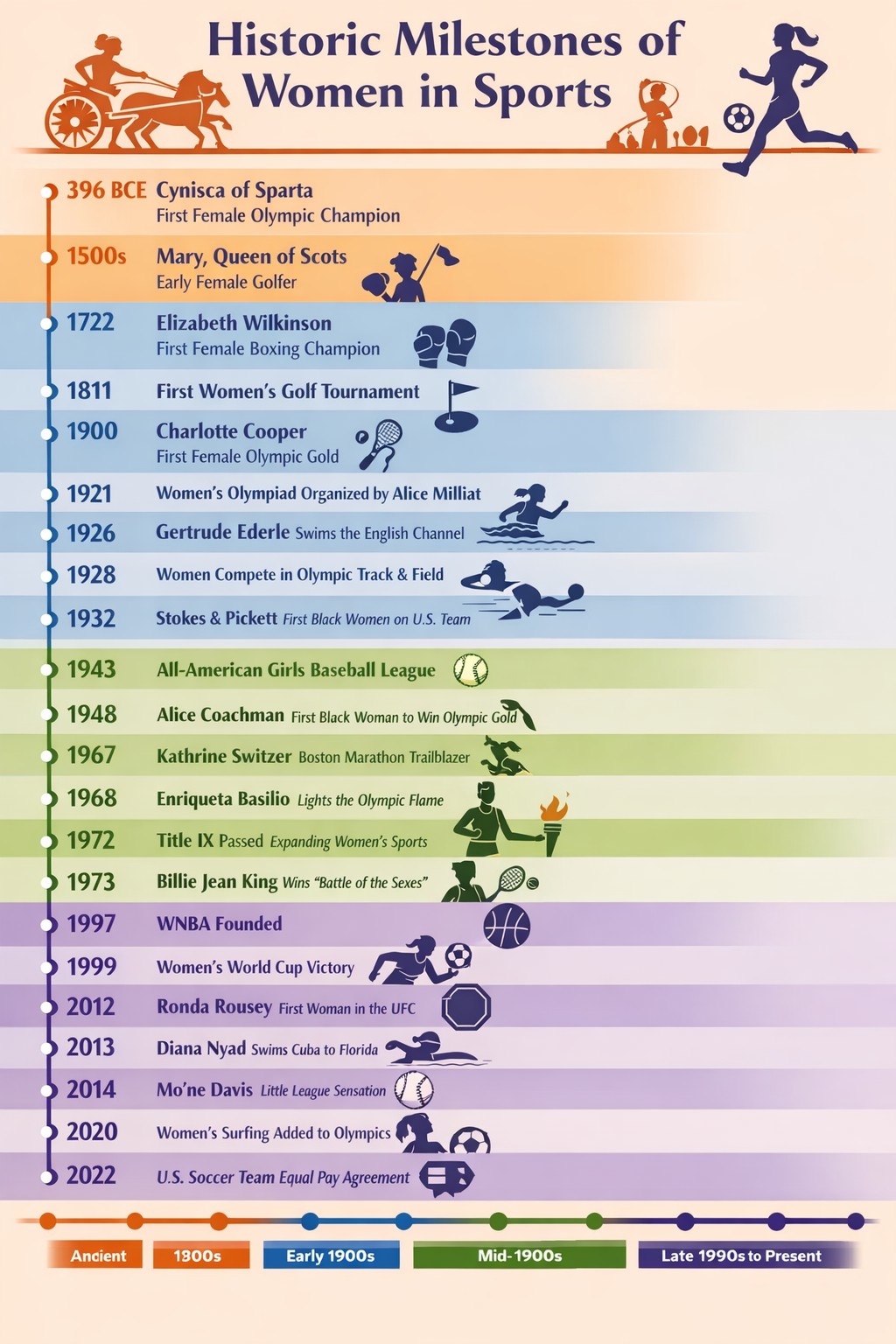
Record-Breakers and Barrier-Smashers: A Timeline of Firsts
396 BCE: Cynisca of Sparta — First female Olympic champion (chariot team owner)
1500s: Mary, Queen of Scots — Prominent early female golfer
1722: Elizabeth Wilkinson — First recorded female boxing champion
1890: First women’s lacrosse game played in Scotland
1900: Charlotte Cooper — First female Olympic gold medalist (tennis)
1921: Alice Milliat organizes Women’s Olympiad in Monaco
1926: Gertrude Ederle swims English Channel faster than any man
1928: Women compete in Olympic track and field for the first time
1932: Louise Stokes and Tidye Pickett — First Black women on U.S. Olympic team
1943: All-American Girls Professional Baseball League founded
1948: Alice Coachman — First Black woman to win Olympic gold
1967: Kathrine Switzer runs Boston Marathon despite officials trying to stop her
1968: Enriqueta Basilio — First woman to light Olympic flame
1972: Title IX passes, transforming American women’s sports
1973: Billie Jean King defeats Bobby Riggs in “Battle of the Sexes”
1997: WNBA founded
1999: FIFA Women’s World Cup fills stadiums, U.S. wins on penalty kicks
2012: Ronda Rousey becomes first woman in UFC; London Olympics include women in all sports
2013: Diana Nyad swims Cuba to Florida at age 64
2014: Mo’ne Davis pitches shutout at Little League World Series
2020: Women’s surfing added to Olympics
2022: U.S. Women’s National Soccer Team achieves equal pay agreement
How These Milestones Paved the Way for Today’s Athletes
From Banned to Celebrated: How Far We’ve Come
The journey from ancient Greece—where women couldn’t even attend the Olympics—to today’s packed stadiums celebrating female athletes represents one of the most dramatic social transformations in history.
The transformation:
- From being told they were too fragile for athletics to breaking world records
- From being banned from marathons to winning them
- From having no professional opportunities to earning millions in endorsements
The truth: This didn’t happen naturally or inevitably. Every milestone required courage, activism, and athletes willing to face criticism, ridicule, and sometimes physical confrontation.
The sportswomen who competed before Title IX, before professional leagues, before equal pay. They did it because they loved their sports and refused to accept exclusion.
Athletes Building on and Adding to the Legacy
Today’s elite female athletes—including the women represented by Athelo Group—compete in a landscape those pioneers created, and they’re actively shaping what comes next.
When Bella Kenworthy surfs in international competitions, she’s not just benefiting from decades of female surfers fighting for recognition—she’s pushing the sport forward and opening doors for the next generation.
When Amy Bream competes in CrossFit, she builds on a culture that celebrated female strength from the start, while proving what’s possible and inspiring future athletes.
When Alex Aust plays lacrosse, she participates in a sport women helped define and develop, and through her performance, she’s redefining what the sport can be.
Every championship, every record, every barrier broken today becomes part of the foundation for tomorrow’s athletes. The work isn’t done—it’s ongoing, and today’s athletes are writing the chapters that future generations will build upon.
What Young Female Athletes Should Know About This Legacy
If you’re a young athlete reading this, here’s what you should know:
You’re part of a story that stretches back thousands of years. The women who came before you—from Cynisca to Kathrine Switzer to Ronda Rousey—fought so you could play.
When you step onto the field, court, track, or water, you carry their legacy.
When someone tells you that you can’t do something because you’re a girl, remember:
- Elizabeth Wilkinson boxing in 1722
- Gertrude Ederle swimming the English Channel
- Alice Coachman jumping for gold on improvised equipment
Your achievements matter. Every game you play, every practice you attend, every goal you score adds to this ongoing story.
Someday, young athletes will look back at what you accomplished and draw inspiration for their own journeys.
Your Turn to Make History
Every race, every game, every training session is part of a story that stretches back thousands of years.
As you chase your dreams, remember the trailblazers who defied stereotypes, pushed limits, and demanded recognition. From ancient athletes in the Games of Hera to modern pioneers in every sport imaginable, women have always been athletes. Society just hasn’t always allowed them to prove it.
Your achievements today write the next chapter of women’s sports history.
When you work hard, compete fiercely, and support other female athletes, you honor everyone who fought for your opportunities. When you refuse to accept limitations, you continue the tradition of barrier-breaking that defines women’s sports.
You are part of a lineage of barrier-breakers who changed the world by refusing to stay on the sidelines.
The athletes who came before you—the influential women in sports history—couldn’t have imagined the opportunities you have today. And the athletes who come after you will benefit from what you accomplish.
Now it’s your turn to make history. What will your chapter say?
Frequently Asked Questions
When were women first allowed to compete in the Olympics?
Women first competed in 1900 at the Paris Games in tennis and golf with just 22 participants. Full inclusion in all Olympic sports didn’t happen until 2012.
Who was the first woman to win an Olympic gold medal?
Charlotte Cooper of Great Britain won tennis singles gold in 1900, becoming the first female Olympic champion. She also won gold in mixed doubles.
What is Title IX and why was it important for women’s sports?
Passed in 1972, Title IX prohibits sex-based discrimination in schools. Before it, only 1 in 27 girls played high school sports; today it’s nearly 1 in 2. It opened opportunities for millions of female athletes.
Which sports were women banned from the longest?
Marathons (Boston Marathon until 1972, Olympics 1984), ski jumping (Olympics 2014), and boxing (Olympics 2012). Some sports still lack full gender parity.
When did women’s professional sports leagues begin?
The All-American Girls Baseball League (1943–1954) was first. Modern leagues include the WNBA (1997) and Women’s Professional Soccer (2001), though opportunities remain limited.
What are some lesser-known milestones in women’s sports history?
Alice Milliat organized the 1921 Women’s Olympiad, Ora Washington excelled in tennis and basketball in the 1920s–40s, Louise Pound set rifle records in the early 1900s, and Enriqueta Basilio lit the Olympic flame in 1968.
How has women’s sports participation changed since 1972?
High school participation rose from under 300,000 to over 3.4 million; college from under 30,000 to over 200,000. Girls now receive more than 40% of college athletic scholarships.
What challenges do female athletes still face today?
Female athletes deal with lower pay and sponsorships than men, and their historical achievements are often overlooked. Investment in facilities, coaching, and development remains unequal. Additionally, female athletes face unique challenges related to pregnancy, fertility care, and balancing athletic careers with family planning.
Featured Image: Gertrude Ederle, first woman to swim the English Channel in 1926. Image courtesy of the Smithsonian National Portrait Gallery (public domain).